
Form T2200 Canada: Rules, Eligibility & Tax Deductions Explained
A complete guide to CRA Form T2200 covering work-from-home expenses, employee deductions, filing requirements, and employer obligations.
MN Edge
6/4/20269 min read
Filing taxes can feel like a maze, especially when it comes to claiming work-related expenses. If you've paid out of pocket for things like a home office setup or job-specific supplies, you may be wondering how to recover those costs at tax time. That's where Form T2200 comes in. It's a straightforward declaration from your employer confirming that you had to cover certain job-related costs yourself, and without it, claiming those deductions becomes difficult.
Form T2200 is a declaration completed and signed by an employer that certifies an employee was required to incur certain work-related expenses, such as home office costs that were not reimbursed. This form enables eligible Canadian employees to claim employment expense deductions on their personal tax returns.
Overview of Form T2200
Form T2200, officially titled the Declaration of Conditions of Employment, is a CRA form completed by an employer to confirm that an employee was required to incur certain expenses to fulfill job duties and that those expenses were not reimbursed. Signing the form does not affect the employer's own taxes, but it plays a critical role for employees who want to claim legitimate work-related expenses.
Its core function is straightforward: it acts as proof for the Canada Revenue Agency (CRA) that an employee's working conditions involve costs that qualify for deductions, whether that's a home office, vehicle use, or supplies used specifically for the job. Without this form, even an eligible employee may struggle to support their claim.
The form contains several key sections:
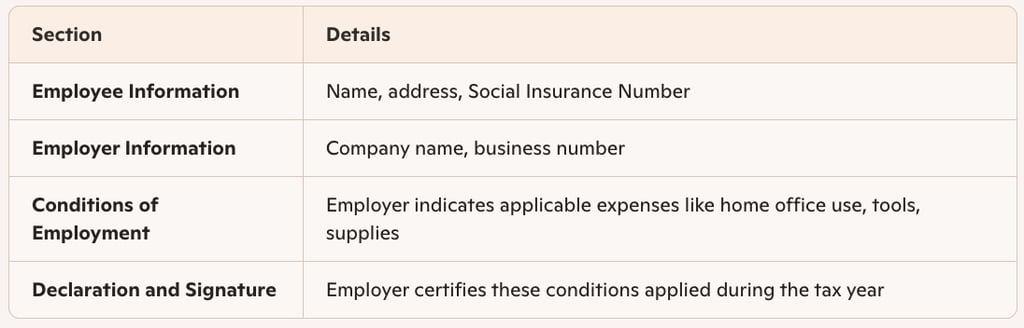
For employers, a useful practice is to provide employees with a completed, signed copy well before the tax filing deadline. For employees, requesting this form is reasonable when you have eligible expenses. It's part of how the Canadian tax system supports workers who pay job-related costs out of pocket.
Many misunderstandings around Form T2200 happen because some employers worry that signing it creates tax liability or extra reporting obligations on their end. In reality, the form simply confirms facts about employment conditions, and responsibility for the expense claim itself sits with the employee.
"Form T2200 doesn't increase an employer's tax burden; it simply gives employees the documentation they need to accurately reflect job-related costs on their return."
With remote and hybrid work now common across Canada, this form has become more important than ever, helping Canadians who cover job-related costs out of pocket claim what they're owed.
When Employers Need to Issue Form T2200
For an employer to be required to complete and sign Form T2200, there must be a clear connection between the employee's job duties and the expenses they incurred. The CRA expects that the employee was required, as a condition of employment, to incur certain expenses and that those expenses were not reimbursed by the employer.
Eligibility often comes down to where and how the employee carries out their duties. If an employee regularly works away from the employer's premises from home, on the road, or at client sites, the expenses they cover personally may qualify. But location alone isn't the deciding factor; what matters is whether the costs were necessary, work-related, and not reimbursed.
Some employers hesitate to issue the form because they worry it creates tax exposure for their company. It doesn't. Form T2200 has no direct tax impact on the employer; it exists solely to support the employee's personal tax filing.
Practically speaking, employers should maintain clear internal policies that document when employees are required to incur costs without reimbursement. Detailed records also make it much easier to respond if the CRA ever asks questions. On the employee side, it's important to know that receiving a Form T2200 doesn't automatically guarantee a deduction; it certifies eligibility to claim allowable expenses when filing.
Conditions Employees Need to Meet to Claim Expenses
To successfully claim employment expenses using Form T2200, certain conditions need to be met. These aren't arbitrary; they're safeguards to ensure only legitimate, unreimbursed, job-related expenses qualify.
A key condition is that the employee must perform their duties primarily outside the employer's regular place of business, often from home or another remote location on a regular basis.
The CRA generally expects that where a home workspace is being claimed, it is a clearly defined area used primarily for work. A kitchen table that doubles as a family dining spot generally won't qualify. A dedicated desk or room set aside for work typically meets the bar. Picture a graphic designer who sets up a small studio in a spare bedroom: a portion of their internet bill, utilities tied to that workspace, and certain office supplies can become claimable because they're directly connected to a dedicated home office.
Another important condition is that claimed expenses cannot have been reimbursed by the employer. If your company already covers your internet bill or pays for your supplies, those costs cannot be claimed again on your tax return. Clear communication between employer and employee helps avoid confusion or worse, an audit headache later.
Work location: Duties performed primarily outside the employer's premises, such as at home.
Dedicated workspace: A defined area used primarily for work.
Unreimbursed costs: Expenses paid out of pocket and not covered by the employer.
Necessary for duties: Expenses must genuinely be required to perform the role.
Deductible Expenses and How to Claim Them
When it comes to deducting expenses under Form T2200, clarity around categories makes all the difference. If you work from a home office, you can typically claim a portion of expenses like utilities or rent but only when the workspace meets CRA criteria for primary work use.
Travel expenses are another common area of confusion. The key question is whether the travel was genuinely required for work and whether the employer reimbursed any of the costs. Out-of-pocket expenses tied specifically to business travel may be deductible, while leisure travel or mixed-purpose trips will not be.
Office supplies items like stationery, printer ink, or equipment used for work must be primarily for business use. Employers certify the necessity of such purchases by completing Form T2200, giving employees solid backing for their claims.
"When it comes to tax filing, careful record-keeping isn't optional; it's essential."
Documentation Tips That Make a Real Difference
A few simple habits go a long way:
Scan or photograph receipts immediately after purchase so they don't fade or get lost.
Use an expense-tracking app that fits your workflow.
Request a signed copy of Form T2200 from your employer ahead of filing.
Keep personal and business expenses cleanly separated in your records.
Form T2200 also needs to be completed using the official CRA fillable PDF, so download the current version directly from the CRA website to avoid formatting issues.
Filing and Documentation Requirements
Careful handling of Form T2200 matters because errors or missing information can lead to denied claims or follow-up requests from the CRA. Employers should complete the form fully and accurately, clearly certifying that the employee was required to incur certain expenses to perform their job.
Once signed, the employer provides the completed form to the employee. The employee keeps it on file as supporting documentation rather than submitting it with their return, unless the CRA specifically requests it.
Along with Form T2200, employees use Form T777 (Statement of Employment Expenses) to detail and calculate the actual expenses being claimed. T777 acts as the financial record within the tax return, summarizing eligible costs like home office expenses, vehicle use, or other job-related spending. Together, the two forms create a clear paper trail linking the employer's certification with the employee's claim.
Beyond the forms themselves, receipts, invoices, and contracts should be retained in case the CRA asks for verification. The CRA generally requires taxpayers to keep supporting records for several years after filing, so a well-organized system, digital or physical, pays off. Accounting software can organize scanned receipts, track mileage, and produce reports aligned with CRA requirements, easing the year-end crunch.
For Mississauga-area business owners and self-employed professionals, building these habits early is one of the simplest ways to keep tax season calm rather than chaotic.
How Form T2200 Affects Your Tax Return
When an employer completes and signs Form T2200, they're confirming that the employee was required to pay certain work-related expenses out of pocket. That certification is what allows the employee to deduct eligible expenses on their personal income tax return, reducing their taxable income.
The most meaningful effect of using Form T2200 correctly is real tax savings. By deducting allowable employment expenses like office supplies, eligible home office costs, or vehicle expenses, employees lower the amount of income that gets taxed. How much that's worth depends on the individual's income, expenses, and province.
It's worth repeating: Form T2200 itself doesn't get filed with the tax return. Employees keep it on hand in case the CRA asks for it during a review. Without it, even legitimate deductions can be disallowed, which can lead to reassessments and unexpected balances owed.
Employers should download the official fillable PDF directly from the CRA website. Employees, in turn, should keep a copy of the signed T2200 along with their supporting receipts and records for the period required by the CRA.
For more guidance tailored to Canadian small businesses and self-employed professionals, visit MN Edge, your trusted resource for employment and tax insights.
Common Questions Employers Ask
One of the most common concerns is whether issuing Form T2200 affects the employer's own taxes. It doesn't. Signing the form does not change your corporate tax position; it is purely a certification that enables the employee to claim eligible expenses on their personal return.
Another frequent question is whether an employer must issue Form T2200 even when they suspect an employee's expenses may not fully qualify. The straightforward answer: employers should only sign the form when the conditions genuinely meet the CRA's criteria primarily, that the employee was required to incur those expenses to perform their duties, and that the costs were not reimbursed. When in doubt, confirm eligibility carefully and have an open conversation with the employee.
A related question: What if the employee works from home but doesn't have a formal telework agreement? The key is documented expectation, written or otherwise, showing that the employee was required to work remotely during the period being claimed. Even informal arrangements can support a Form T2200 claim, provided there's consistent documentation behind them.
Reimbursement is another common source of confusion. Expenses that have been reimbursed by the employer cannot also be claimed by the employee on their tax return. Drawing that line clearly helps keep filings accurate and audit-ready.
"Clear employment conditions plus consistent documentation make for a much calmer tax season for everyone involved."
Key Takeaways for Employers
Confirm CRA eligibility: Ensure expenses meet CRA requirements before signing Form T2200.
Corporate tax position unchanged: Issuing Form T2200 does not affect the company’s tax obligations.
Document remote work expectations: Clearly outline remote work policies and expectations for employees.
Distinguish reimbursed vs. unreimbursed: Carefully separate reimbursed expenses from those employees must claim.
Share trusted resources: Provide employees with reliable guidance to file claims correctly.
Employers who take a proactive approach to Form T2200 tend to navigate tax season with a lot less friction, and their employees feel supported in the process. If you have questions about Form T2200 or want personalized guidance for your business, reach out to us.
Frequently Asked Questions
1. What is T2200?
T2200 is a Canada Revenue Agency (CRA) form titled the Declaration of Conditions of Employment. It's completed and signed by an employer to confirm that an employee was required to pay for certain work-related expenses out of their own pocket as part of their job. Employees in Canada use this signed form to support claims for employment expense deductions when filing their personal income tax return.
2. What is the T2200 form in Canada?
In Canada, the T2200 form is the official document that links an employee's job conditions to the work-related expenses they personally cover. Employers fill it out to certify details such as whether the employee was required to work from home, use their own vehicle for work, or purchase supplies needed for their role and confirm that these costs were not reimbursed. It is a Canada-specific form issued and governed by the CRA.
3. What is the T2200 form used for?
The T2200 form is used to give employees the documentation they need to claim eligible employment expenses on their personal tax return. While the form itself isn't submitted with the return, it acts as proof that the employee was required to incur those expenses. Common deductions supported by a T2200 include home office costs, vehicle and travel expenses, and certain office supplies. Employees pair it with Form T777 (Statement of Employment Expenses) to actually calculate and claim the deduction.
4. What is CRA Form T2200?
CRA Form T2200 is the official Canada Revenue Agency declaration that an employer completes to verify the conditions of an employee's job. It does not affect the employer's own tax position; it simply confirms that the employee was required to take on certain unreimbursed costs to perform their duties. The form must be downloaded as the official fillable PDF directly from the CRA website to ensure it is the current, accepted version.
5. Who needs a T2200 form, and how do I get one?
Any employee in Canada who was required to pay for work-related expenses such as home office costs, vehicle use, or supplies that were not reimbursed by their employer may need a T2200. To get one, simply ask your employer to complete and sign the form for the relevant tax year. Employers are generally expected to issue the form when an employee meets the CRA's eligibility conditions. Once signed, keep the form with your tax records in case the CRA requests it during a review.
Take the Stress Out of Corporate Tax Filing
Ensure your business stays fully compliant and maximizes tax efficiency with expert corporate tax filing services from MN Edge. Our experienced team helps you navigate complex tax regulations, organize all required documentation, and file accurately to avoid errors or penalties. Call us today at (905) 599-2701 and let MN Edge simplify your corporate tax filing so you can focus on growing your business with confidence
CONTACT US
Get in touch for personalized tax help
Email 📧
Phone 📞
MNedgeca@gmail.com
© 2026. All rights reserved.
+1 (905) 599-2701
Our Services
Tax Services
Corporate Tax Filing